
“And I have walked the hollows here
In the still and breathing night
Along the creek bed roads and winding paths.
I have heard the jewelled drip of dew
On dead leaf beds, the hoot owl’s jocular gossip,
And the tiny screech owl’s shivering,
Complaining lyric.
I have listened for the first morning whippoorwill,
And, in the deep well of night and sleep,
For the lost to return.”
Al Stewart
In the Kingdom at Yellow Mountain (1980)
During our recent trip back to the mountains to visit Ima’s sister, I noticed the name on a highway spur from Hindman, Kentucky to Route 80: the Albert Stewart Highway. The sign – meant to be a tribute to a well-known poet local son – fell far short of describing the man that was my friend.
Perhaps some of you who knew him as well will think that this missive, also meant to be a tribute to Al, will likewise fail to portray the full measure of a man that meant so much to us.
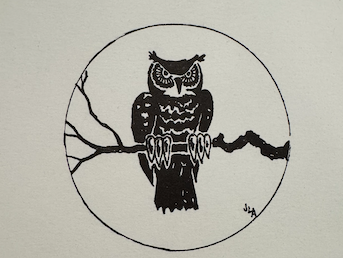
At any rate, Ima found a Christmas card last week (the artwork depiction of the owl that accompanies this missive) while she was rearranging our stack of boxes in the garage. I had been thinking about the card for some time. I remembered designing the owl (one of my favorites designs because of its simplicity and purpose) for Al’s card during my early years on the Alice Lloyd College campus. The simple black-and-white owl card was printed by Elmer Slone in the college print shop. Perhaps some of you may recall that the print shop in those days was just upstairs from my office in old Cushing Hall. At the time, I wore two hats on campus: Director of Public Relations and History Professor.
But back to the card. Al gave the card to his campus friends with his poem on the card’s other side and the words “season’s greetings” below. Today, the card – and the torrent of memories it evokes – is one of my most prized possessions from those days.
Albert F. Stewart (1914-2001) was a bit of a legend on our tiny college campus perched in the southern Appalachian Mountains and nestled along Caney Creek in eastern Kentucky. According to Gurney Norman, Al “designed his own literary career, a career equal in value to that of any post-war Kentucky writer.” [1]
I had seen Al several times on campus, but I didn’t really get to know him until after a chance meeting at my office.
He was walking by on his way to the print shop.
I was doodling a picture on my desk.
I did that a lot while thinking over class lectures.
He walked in and looked over my shoulder.
It was a drawing on a piece of college stationary. The sketch portrayed an old mountain man based on a black-and-white photograph from Chip’s photo archives.
“I like that,” Al said, “can I use it for my magazine?”
I was flattered.
“Of course,” I replied.
That was the beginning of our artistic partnership.
Al was the editor of Appalachian Heritage magazine. The highly respected magazine was dedicated to preserving the local mountain culture and heritage as well as encouraging local writers. As Al put it: “There was so much claptrap being written about people in the area, I thought I’d just do a magazine that showed everybody wasn’t a poverty-stricken moron up here.”
I grew to admire Al, his magazine and his homespun mountain philosophy. Others knew him as a cantankerous old fart who could put you to sleep with his monotone classroom lectures. But I relished his friendship and, over the next several years, I would design several covers for various editions of the Appalachian Heritage magazine and illustrate several of his author’s stories.
Al was a true child of the mountains. He was a fount of information on the history of Caney Creek – the ribbon of water that trickled through the middle of the college – and the rich cast of characters drawn like a magnet to the remote mountain campus.
Let me provide you with one of several memories. On the margins of Appalachian Day, Colin Philipps (the youngest of the onery three boys of Bill and Belle), was playing near the old brown stone student store. At the time, the store stood in the center of the meadow. (Today the student center and June Buchanan School occupy this space where our intramural football wars used to be waged). The blond-headed Colin, a toddler at the time, was squealing with delight as he took a stick and poked at tiny creatures curling upward – a nest of baby copperhead snakes. Colin was too young to recognize the danger. As Al and I laughed about incident later, it prompted a discussion about snakes on campus. “In the old days,” Al informed me, “they kept pigs here along the creek and the pigs solved the snake problem.”
(We didn’t have pigs on campus during my time there. Another of my memories is encountering a huge copperhead sunning itself on the stone steps leading up to the Commodore Slone Building which at the time housed the June Buchanan School. I took a big stone and repeatedly bashed the head of the snake until it was thin as a piece of paper. As I prepared to pick up the snake by the tail and throw it away, the snake coiled by instinct to strike – even though it had a smashed head, and no fangs left. The memory of that event is forever etched in my mind, and I have used it from time-to-time as a metaphor for the lingering effects of sin in the life of a believer).
At any rate, I don’t know why I remember that incident or Al’s bit of history about snakes on Caney Creek so clearly. Colin is now probably close to fifty-years old, (I nicknamed him the “Whampusburger” years ago) and lives with his mom in Savannah, Tennessee. Bill Philipps, a remarkable man who was such an important mentor in my life, passed away several years ago.
But I digress.
Back to Al.
He loved Bill, Belle and the boys.
He also grew very fond of us. Al would call Ima and I “Imajeemes” when he saw us together. During our “sparking days” we became frequent visitors to his simple, old two-story wooden house on his property – his beloved “Yellow Mountain Kingdom” – where we would sit on his undulating porch and solve the problems of the universe. In the surrounding woods there were fireflies too numerous to count and magical evening sounds. On a couple occasions, we even sampled his latest homemade wine.
In our frequent early-evening conversations, I found Al to be a repository of practical mountain wisdom, a valuable source of information concerning the history of the people and events of the area and, above all, a fierce defender of the mountain culture.
Al’s love for the local culture carried over into his editorial duties. In those pre-computer days that was a huge commitment of time and effort. He would have to set major parts of the magazine by hand – cutting letters for the story headings and pasting them on sheets to be printed for example – and coordinating and editing the pieces themselves. He was good at it, but the time involved didn’t allow him time to work on his own writing or any sort of self-promotion. His personal poetry from The Untoward Hills (1962) and his letters contain rare treasures reserved for his closest friends. One of his ideas that I particularly like: “Tell them nobody’s free and oughtn’t to be. Say Everybody’s bound, the difference is what binds.” In Al’s view true dignity came from choosing to be bound to the right things.
And what Al was bound to, even more than editing his magazine, was fiercely defending the heritage of his beloved mountains from the corrosive effects of progress. He valiantly fought the process of imminent domain (beginning in 1976) whereby the state divided his “Yellow Mountain” ancestral homestead along Ball’s Fork for new highway 80, a part of the Mountain Parkway connecting Hazard and Prestonsburg. As such, the highway connector (officially designated as part of KY-160 or the Hindman Bypass) dedicated in his honor constitutes the classic Appalachian paradox: the state named a piece of concrete after a man who spent years fighting to stop it from being poured.
As a final gesture of defiance, in the early 1980s Al attempted to ensure the remainder of his land could never be exploited by commercial developers or coal companies. He donated the remained 200 acres or so of his mountain farm to the University of Kentucky. In the process, Al attached a legally binding condition to the deed: the old-growth trees, the physical landscape, and the underground minerals had to be preserved for forestry, wildlife conservation, and agricultural research.
Al was also a man of mystery. He never spoke of his years as a sailor in the South Pacific during World War II, his former wives and children, the death of his mother at the age of two, his high school teaching experience in Ohio, or his spiritual leanings – if any. I find it somewhat disappointing that I only recently learned of many details from a recent Carnegie Center biographical sketch rather than from Al himself.[2]https://carnegiecenterlex.org/hall-of-fame/albert-stewart/
“Sigh.”
A few days ago, Ima and I drove by Al’s old farm estate as we traveled down the “new” Highway 80. (Actually, not so “new” anymore – the road is now over 45 years old). You can no longer see Al’s house from the highway (I’m not even sure the physical structures are there any longer) and the old lane leading from the road to his house and barns is overgrown. As we drove by, Ima and I fondly recalled an autumn afternoon so many years ago where we gathered with Al, and our friends Bill and Belle and the boys, for a weekend picnic on a nearby hill. Our eating place was smack in the middle of the road being constructed – the very road that Al unsuccessfully fought to prevent. I remember us scrambling across huge boulders displaced by bulldozers and recall how we speculated whether the new highway would bring additional business opportunities to the people of the mountains (as the promoters of the project had billed it).
It hasn’t.
The road has brought access to the mountains and, curiously enough, has facilitated a means of escape for those young people fleeing the mountains in search of better business opportunities elsewhere.
In that sense, Al was probably right.
As a final note, when I think of my friend Al Stewart, I recall a quote by William Blake: “Great things are done when men and mountains meet.”
Jeemes Akers is the author of the futuristic techno-Christian trilogy: Prawnocuos Rising; Prawnocuos Resplendent; Prawnocuos Falling. You can purchase the books on https://jeemesakers.com. The trilogy tells the story of a group of Christian youths, living some 30-35 years in the future, who are dealing with an increasingly techno-paganist world as they, and newfound friends, frantically race around the globe in a bid to halt the next pandemic and fend off powerful global technological megacorporations. Jeemes also writes missives, or essays, and shares them as well as his original artwork on his website https://jeemesakers.com/
[1] Cited in the Carnegie Center’s biographical sketch of Al Stewart celebrating his induction into the Kentucky Writer’s Hall of Fame (see note below). ↩https://carnegiecenterlex.org/hall-of-fame/albert-stewart/
[2] Carnegie Center for Literacy and Learning, (Al’s induction into Kentucky Writer’s Hall of Fame), see https://carnegiecenterlex.org/hall-of-fame/albert-stewart/. For other information pertaining to Al see: Stewart, Al, The Untoward Hills, Morehead State College Press, 1962; The Holy Season: Walking in the Wild, Berea College Press, 1993; and A Man Of Circumstance and Selected Mountain Poems 1946-1996, (Lubbock Texas, Limited Editions Press, 1996). Al’s papers are archived at Berea College (KY). My portrait illustration of Al with his house in the background can be found in a collection of Al’s poems in Mantrip No. 8 (Oral History Project, Wheelwright High School), Fall 1989, pp. 45-48. The portrait is also in the Gallery section of my artwork at my website jeemesakers.com. ↩